How Governments Can Improve Local-Level “Ease of Doing Business”
Generally, governments assess the ease of doing business at the state and national levels through indicators such as regulatory frameworks, investment policies, and business environment rankings. However, businesses experience the actual operating environment most directly at the local level, where they interact with municipal regulations, licensing procedures, infrastructure, and service delivery systems. Complex permit processes, inconsistent enforcement, and inadequate urban infrastructure often hinder business growth. To achieve the vision of Viksit Bharat 2047, cities must reduce or remove these local barriers.
The figure below summarizes the idea of drill down.
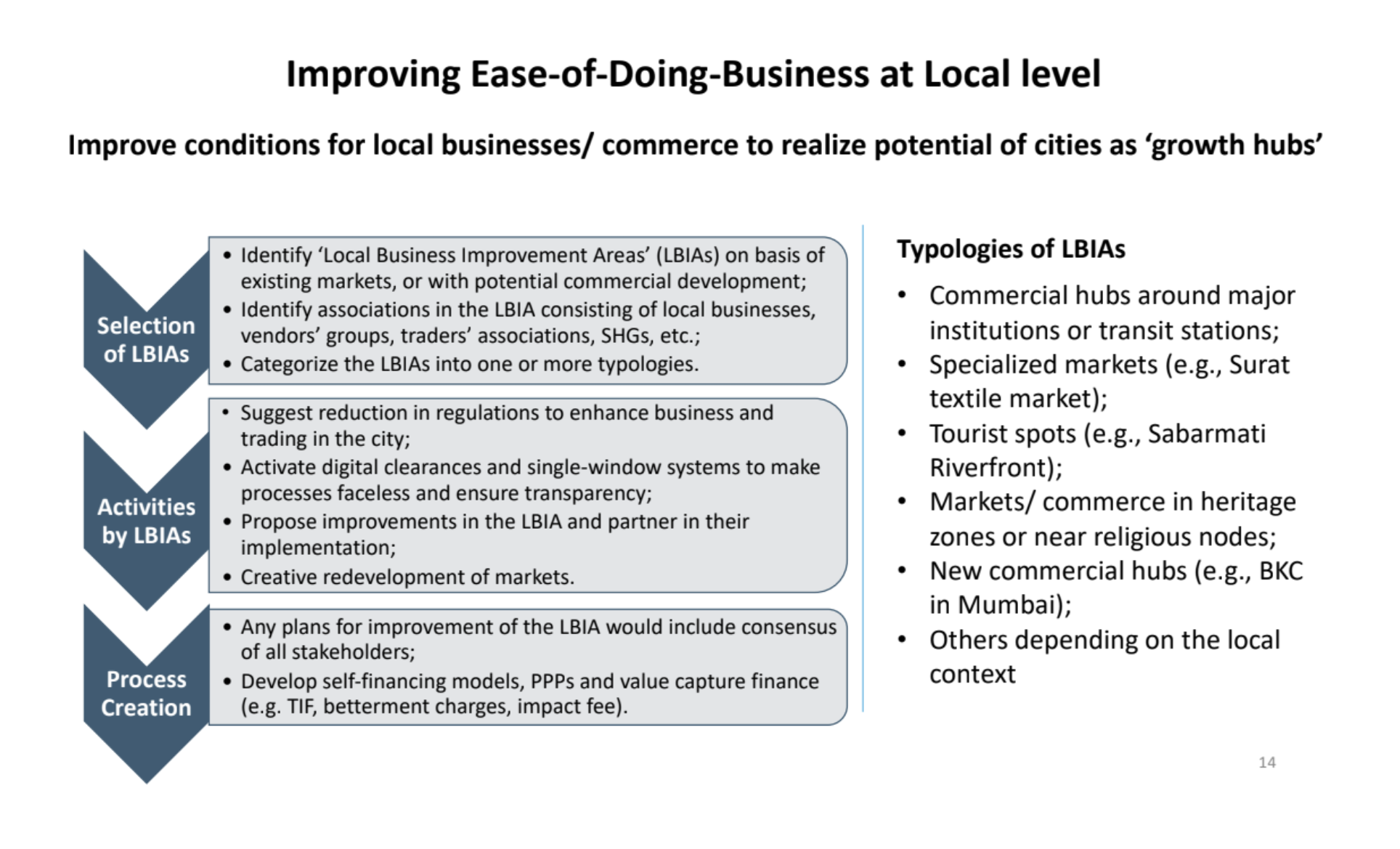
The drill process consists of the following steps:
1. Delineate Local Business Improvement Areas (LBIAs)
Identify and designate LBIAs based on:
Existing markets and market streets
Mandis
Commercial areas near transit stations and tourist landmarks
Localities with a high concentration of SMEs, household industries, and commercial establishments
Other areas with strong future commercial potential for LBIA development.
2. Categorize LBIAs
Classify LBIAs into one or more of the following categories:
Commercial markets centered around major anchor institutions
Transit stations, redeveloped railway stations, and multimodal hubs (e.g., Kashmiri Gate)
Specialized markets such as Surat textile markets or mandis
Commercial hubs around tourist spots, heritage areas, waterfronts, and religious landmarks (e.g., Sabarmati Riverfront, Ayodhya, Musi in Hyderabad, Amritsar, Kashi, Jama Masjid)
Emerging commercial centers such as BKC in Mumbai
Other locally relevant categories
3. Identify and Engage Associations
Identify associations within each LBIA, including:
Local business associations
Vendors’ groups
Traders’ associations
Self-help groups (SHGs)
4. Define LBIA Functions
The LBIA should undertake the following activities:
Recommend regulatory reforms to promote business and trade
Enable digital clearances and single-window systems to improve transparency and simplify procedures
Propose and support local improvements, including:
Transport and mobility upgrades,
Pedestrian-friendly streets (e.g., Chandni Chowk),
Parking management,
Sanitation and public space cleaning, and
Improved street lighting and public safety amenities.
Conduct marketing campaigns to attract consumers, investors, tourists, and commercial tenants
Develop branding strategies, including logos, slogans, signage, and publications
Reorganize vendors to improve customer movement
Undertake capital improvements such as:
Urban design interventions (e.g., Chhappan Dukan in Indore),
Landscaping,
Storefront renovations, and
Street furniture and public art.
Recommend special regulations that encourage:
Mixed-use development,
Liveable densification, and
Emerging uses such as co-working spaces, museums, exhibition spaces, and performance areas.
Promote innovative redevelopment and revitalization of markets
The responsibility for monitoring of services and supervision of local functionaries of all departments in their areas would be entrusted to the associations. They would also propose regulatory reforms.
5. Ensure Stakeholder Participation and Financing
All LBIA improvement plans should emerge through consensus among stakeholders, with clearly identified local goals and shared priorities. LBIAs would generate and utilize their own funds for:
Service delivery improvements
Capital works
Park and public toilet maintenance
Parking management
Waste collection, and
Public safety initiatives
6. Use Value Capture Mechanisms
As economic activity increases within the LBIA, cities can use value capture tools to fund future improvements and maintenance. These may include:
Tax increment financing and betterment charges
Contributions from businesses and landlords benefiting from LBIA improvements, and
Matching funds from city, state, or central governments
LBIA locations must be carefully selected. International experience shows that this model does not succeed everywhere. Successful implementation requires:
Clear institutional structures
Transparent procedures
Strong representation mechanisms
Broad support from residents and businesses, and
Institutionalization through detailed rules and standard operating procedures (SOPs)
By establishing strategic LBIAs, cities can create environments that support entrepreneurship, innovation, and SMEs. Well-designed LBIAs can attract investment, create jobs, strengthen local economies, and help cities leverage regional advantages such as industrial estates and commercial clusters. States and cities that plan and manage LBIAs effectively are likely to experience faster and more sustainable economic growth.