Democratic Administration in Practice
The only title in our democracy superior to that of the President – is the title of the Citizen. - Louis Brandeis
The idea of democratic administration was propounded by Vincent Ostrom, who claimed that Democratic Administration was Public Administration, i.e., built where citizen preferences counted, and residents supervise functionaries and monitor services that matter to them.
Vincent Ostrom, with Elinor Ostrom, founded the “Bloomington School” of political economy. Their goal was to leverage on the unique self-organizing capacity of people. This was a kind of self-governance that opposed the conventional monolithic, hierarchical bureaucracy.
Weber once said that the ideal bureaucracy was one big pyramid. There is a clear chain of command, rules for everything, and experts on top. In response, Ostrom said that’s monocentric and it fails complex societies. Democracy needs polycentric administration with many overlapping centers: Municipality + RWAs + water users association + state board all handling water.
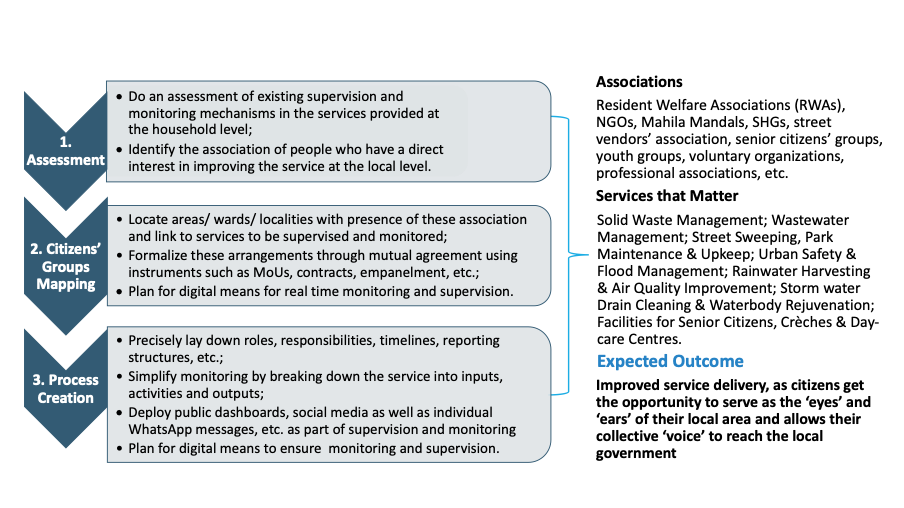
Service delivery in cities needs to be efficient and accountable for people to experience ease of living. Some services that can be directly supervised and monitored by citizens’ groups in their local area are:
Solid waste management (e.g., Ambikapur and Indore)
Decentralised wastewater management (e.g., Bengaluru)
Street sweeping
Park maintenance and upkeep (e.g., Delhi RWAs and Bhagidari Scheme)
Safe localities
Rainwater harvesting
Air quality improvement
Urban Flood management
Cleaning of storm water drains
Waterbody rejuvenation
Identification and provision of space for senior citizens, creches, day care centres and running of these facilities
The steps to enable self-forming associations of people to supervise and monitor services that matter to them are outlined below:
Step 1: Assess existing supervision and monitor mechanisms in the services given above at the household level;
Step 2: Identify associations of people who have a direct interest in improving the service at the local level. Some of these associations could include Resident Welfare Associations (RWAs), slum-level federations, registered institutions, NGOs, Mahila Mandals, Merchant Chambers, SHGs, market and traders’ associations, street vendors’ association, senior citizens’ groups, youth groups, voluntary organizations, professional associations (planners, doctors, urban designers, architects, engineers, artists), and others;
Step 3: Locate areas/ wards/ localities with presence of these association and link to services to be supervised and monitored;
Step 4: Formalize these arrangements through mutual agreement using instruments such as MoUs, contracts, empanelment etc.;
Step 5: Lay down precise roles, responsibilities, timelines, reporting structures etc. Ensure no citizen associations or group of citizens are ignored, particularly the poor and the disadvantaged;
Step 6: Simplify monitoring by breaking down the service into inputs, activities and outputs. For example, in the case of sanitation services, the input would be worker attendance and material availability. The activities would be workers sweeping streets and collecting garbage from households. The outputs would be clean streets. All these could be monitored by city or phone cameras and the information shared with interested households in the particular area; and
Step 7: Plan for digital means to ensure monitoring and supervision. Deploy public dashboards, social media, as well as individual WhatsApp messages, etc. as part of supervision and monitoring.
Expected Outcomes
Improved service delivery, as citizens get the opportunity to serve as the ‘eyes’ and ‘ears’ of their local area and allows their collective ‘voice’ to reach the local government so that they can advocate necessary improvements in service provision and delivery. Overall, democratic administration will facilitate free and equal participation of city-residents, at scale, in municipal activities that matter to them in their daily life. This enhances the accountability and responsiveness of local functionaries towards citizens.