Do Meetings Always Have to “Suck”?
The problem is that few managers have been trained to lead meetings effectively. - Steven Rogelberg, Organizational scientist
The Cabinet Secretary’s call to organize meetings better is timely. Meetings, when done well, have the potential to create solutions that no individual can do alone. Yet, the common perception is that meetings suck: taking away precious time, reducing our energy levels, and drawing down motivation.
The problem is that few of us have been trained to conduct meetings effectively: research shows that only about a quarter of us have received training on how to hold a meeting. We tend to rely on intuition and recycle the jaded practices that we have experienced ourselves.
Even more alarming: we generally think we are better at meetings than we really are. When we have this personal blind spot, we’re not motivated to make changes because we think the problem lies elsewhere. The recent Cabinet Secretary’s two-page note accompanied by a 10-page guide is an acknowledgment of this.
The five common traps of meetings are:
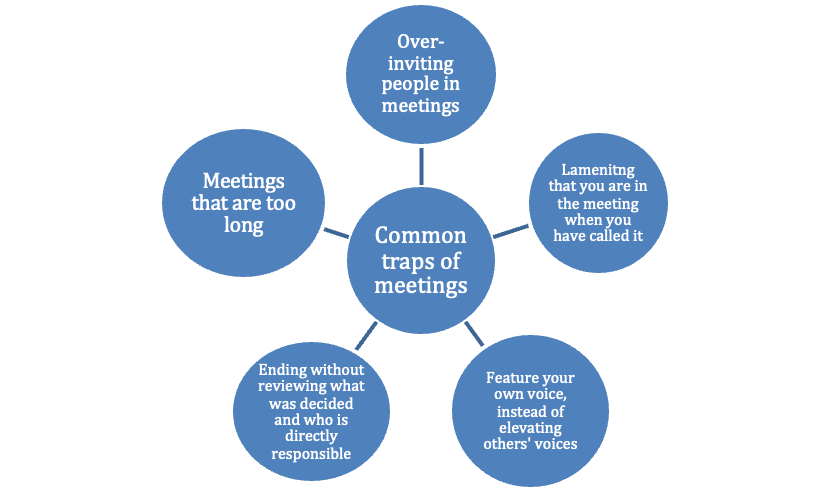
How do we stop falling into these traps? Some rules of the thumb are outlined below:
Separate Conversations, and “Optional” Invitees: Generally, we know who should come to particular meetings. The problem comes when we confuse must-haves with nice-to-haves. This can be sorted out by having separate conversations or a partial invite with nice-to-haves. Remember that large meetings also stifle participation, especially from people who perceive their status to be relatively low in the hierarchy.
Achievement-Oriented Agendas: Frame the agenda as a set of questions to be answered instead of issues to be discussed. This will make the meetings achievement-oriented and give you a better sense of who to invite.
Set Specific Meeting Outcomes: Instead of issuing vague asks that result in participants spinning their wheels to deliver something over-the-top or not aligned with your vision, include the why. Share your intent. Where do you ultimately want to end up?
Engage Deeply: Bring in the devil’s advocate by asking “what if” questions to promote deeper conversations.
Timely Start: Meetings that start late are also much less productive: meetings that started 10 minutes late were a third less effective - in terms of outcomes, both actual and perceived - than a meeting that started on time. So, start your meetings on time!
Be a Strategic Contributor: A blind spot in meetings is the simple inability to stop talking. Overtalking often stems from a desire to escape silence and the compulsion to bring every discussion back to us (conversational narcissism). Importantly, the more we talk in meetings, the less we contribute, undermining our influence and leaving people unsure of where we stand. The way out is to practice strategic silence: consciously pause after asking questions and resist the urge to fill quiet moments, instead creating space for reflection.
Years ago, I had a boss who loved meetings, and a boss who saw a full calendar as a proxy for productivity. During the meetings I used to recall Fyodor Dostoyevsky’s time in a prison camp, where the worst form of torture was forcing people to endlessly perform a pointless task. Using the above heuristics will empower you to avoid the five common traps of meetings and dispel the perception that meetings are torturous and unproductive.