
Are KPIs A Silver Bullet?
In today’s organization, there is a temptation to replace observation with measurement. - Debashish Chatterjee
In the past 25 years or so, CEO-type political executives have ascended in governments in India and measurement is becoming the flavour of all seasons. This was facilitated during the 1990s when public administration entered the New Public Management (NPM) phase.
However, there is a flip side: all of us have experienced that some services are marked as “live” by simply creating a webpage, while the actual backend workflow remains as manual and cumbersome as before. In such cases, the terms “digitalization” and “re-engineering” are used, but the true transformation is not up to expectations!
New Public Management is based on the famous dictum: you cannot manage what you cannot measure. However, this comes up against the Goodhart's Law:
"When a measure becomes a target, it ceases to be a good measure."
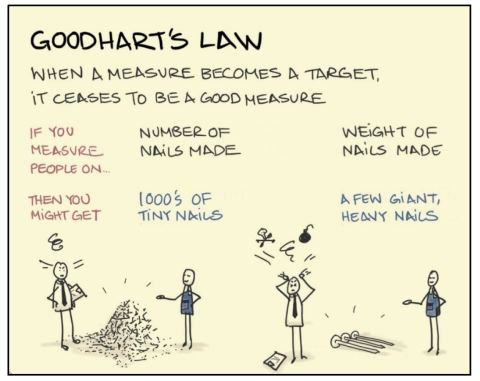
So, the trap is: if you measure the wrong thing, you manage the wrong thing! And, people tend to game KPIs:
Design a metric → Work to hit the metric → Game the system to “win.”
Gaming is more of a symptom than a problem: because metrics don’t just measure performance, they manufacture behaviour in a way we don’t want. Bad metrics don’t just fail to create value. They actively create dysfunction. They train people to win the scoreboard, not the game.
The lesson is clear: metrics should measure true outcomes, not just optics. Otherwise, we end up rewarding “gaming” instead of genuine performance improvement.
How to measure real performance?
Culture design matters: As professor Boman Moradian used to say: people perform on what is measured, and how frequently it is measured. This is where culture matters. If the measures don’t align with values, people will always ‘game’ the system. This is the truth we rarely admit: metrics don’t just measure performance; they generate unintended behaviours.
True leadership is about setting metrics that fuel purpose and performance - not just perception.
Real performance gains come from measurement design, not so much from enforcement.
KPIs can be deceptively complex - once a system is put in place to measure performance, employee behaviour often shifts to align with the new metrics. Before introducing a new KPI, it's valuable to explore scenarios where even an improved metric might not lead to the desired results. In many cases, a single KPI doesn't capture the full picture and must be interpreted alongside other relevant indicators. It highlights how focusing on a single, narrow metric can lead to unintended consequences and a false sense of success. The key is to design metrics that truly reflect the desired outcome, not just a small piece of it.
So, the key takeaways:
People building KPIs should have the expertise to visualize every possible scenario and then write the KPIs.
Hitting metrics doesn’t always mean delivering value.
Perception can be engineered, even if the process stays broken.
Poorly designed KPIs lead to unintended behaviours - KPI gaming is a symptom, not the problem.
If you want real performance gains: start with better measurement design - not just better enforcement.